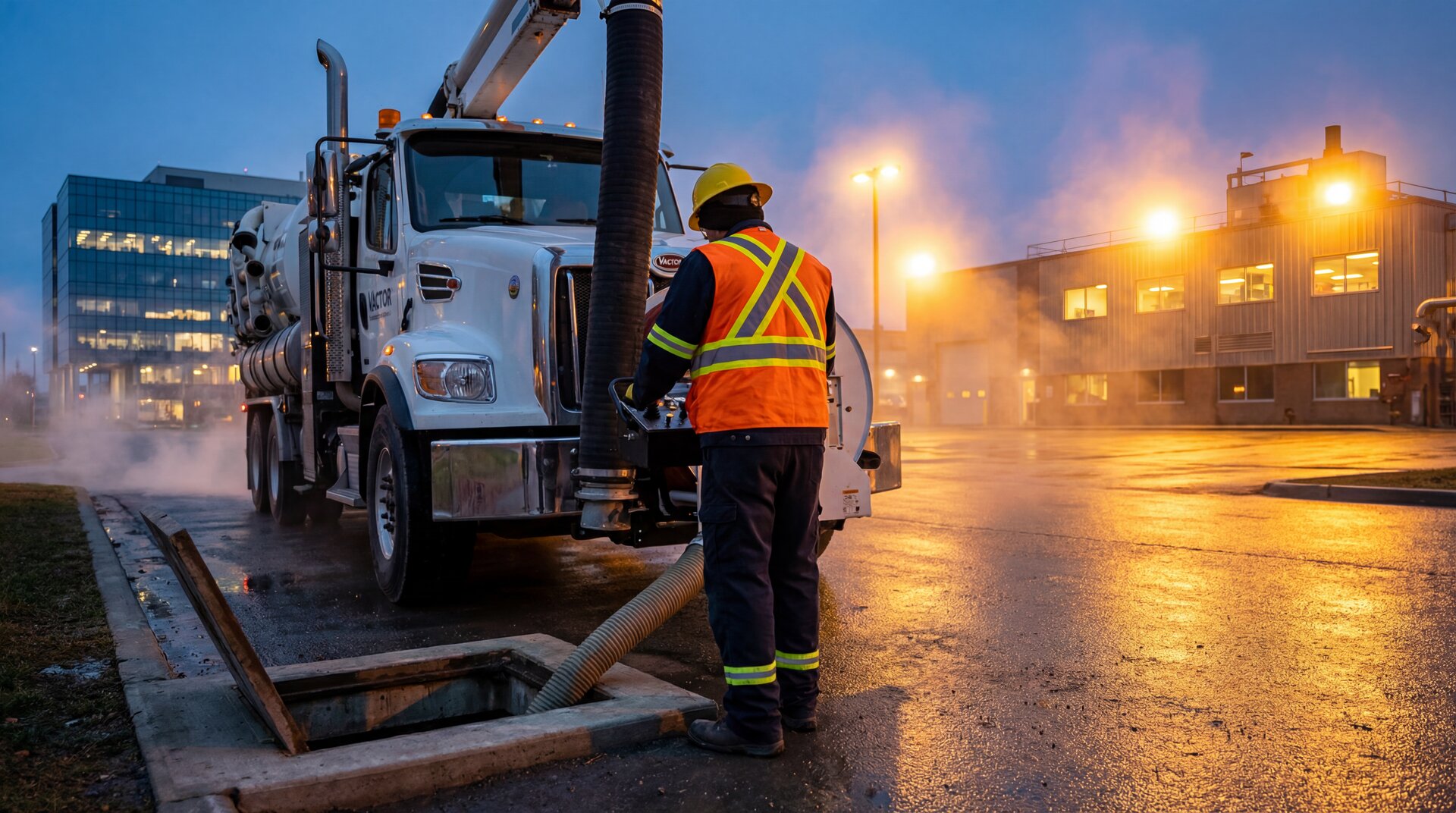
Why Cleveland and Lake County Need Professional CCTV Sewer Inspection
The sewer infrastructure beneath Cleveland, Lake County, and communities across Northeast Ohio is aging. Many of the sanitary sewer lines serving Eastlake, Mentor, Willoughby, Wickliffe, Willowick, and Painesville in Lake County — along with Cleveland, Lakewood, Parma, and Euclid in Cuyahoga County — were installed between the 1920s and 1960s. These pipes were built with vitrified clay, brick, and early-generation cast iron, materials that have been deteriorating underground for 60 to 100 years. Without CCTV sewer inspection, municipalities and property owners across Cleveland and Lake County are making infrastructure decisions blind, unable to see the cracks, root intrusion, joint separations, and structural failures accumulating inside their pipes every year.
CCTV sewer inspection gives Cleveland and Lake County decision-makers the data they need. A NASSCO PACP-certified camera inspection provides objective, standardized condition ratings for every pipe segment — ratings that Ohio EPA, the Northeast Ohio Regional Sewer District (NEORSD), engineering firms, and municipal finance departments all accept for compliance documentation, capital planning, and rehabilitation prioritization. For Ohio municipalities facing consent decrees, MS4 permit renewals, or NPDES compliance reviews, CCTV inspection data is not optional — it is the foundation of every defensible infrastructure plan.
EnviroFlow USA is a NASSCO triple-certified CCTV sewer inspection contractor based in Eastlake, Ohio — right in the heart of Lake County. We serve municipalities, utilities, engineers, commercial property owners, and homeowners across Cleveland, Lake County, Cuyahoga County, and seven Northeast Ohio counties with PACP, MACP, and LACP coded inspections, GIS-compatible data delivery, and combined hydro jetting and inspection capability in a single mobilization.
Lake County & Cleveland infrastructure fact: The Northeast Ohio Regional Sewer District manages over 300 miles of interceptor sewers with approximately 200 combined sewer overflow (CSO) outfalls. Municipalities across Lake County and Cuyahoga County are increasingly required to conduct CCTV inspections as part of system evaluation studies, consent decree compliance, and asset management programs mandated by Ohio EPA.
Municipal CCTV Inspection Programs for Ohio Communities
Ohio municipalities — from small Lake County villages like Kirtland and Madison to large cities like Cleveland and Akron — face the same infrastructure challenge: aging sewer systems that need systematic condition assessment before rehabilitation dollars can be allocated effectively. A well-designed municipal CCTV inspection program is the starting point for every smart infrastructure investment. Without objective NASSCO-coded condition data, municipalities across Cleveland and Ohio are guessing about which pipes need replacement, which need rehabilitation, and which can be deferred — guesses that waste taxpayer money and leave critical failures undetected until emergencies force expensive reactive repairs.
What Ohio Municipalities Get From EnviroFlow's CCTV Program
EnviroFlow USA designs and executes municipal CCTV inspection programs tailored to each Ohio community's specific infrastructure, regulatory requirements, and budget. Our municipal CCTV inspection services for Cleveland and Lake County communities include: a systematic inspection schedule covering priority areas first (oldest pipes, known problem areas, consent decree zones), NASSCO PACP/MACP/LACP coded condition reports that meet Ohio EPA and NEORSD submission requirements, GIS-compatible data delivered in Esri ArcGIS or QGIS format for integration with your municipal mapping system, rehabilitation cost estimates and priority rankings to support capital improvement program (CIP) budgeting, and combined hydro jetting pre-cleaning plus CCTV inspection in one mobilization to reduce per-foot costs.
For Ohio municipalities evaluating CCTV inspection contractors, the critical differentiator is certification and data quality. Many contractors offer "sewer camera" services, but not all produce NASSCO-coded data that Ohio agencies accept. EnviroFlow USA holds current PACP, MACP, and LACP certifications — the full NASSCO triple certification — ensuring every inspection report we deliver to Cleveland, Lake County, and Northeast Ohio municipalities meets the highest industry standard without re-inspection risk.
Pre-Purchase Sewer Inspection in Cleveland & Lake County
Pre-purchase sewer camera inspection is one of the smartest investments a property buyer in Cleveland or Lake County can make before closing. Sewer lateral replacement in the Cleveland area costs $5,000 to $25,000+ depending on depth, length, surface restoration, and connection type. A $250-$500 CCTV camera inspection before closing reveals the actual condition of the sewer lateral connecting the property to the municipal main — identifying root intrusion, pipe cracks, offset joints, bellied sections, and other defects that are invisible during a standard home inspection but can cost thousands to repair after purchase.
How Pre-Purchase Sewer Inspection Works in Cleveland
EnviroFlow USA deploys a push camera through the sewer lateral from a cleanout or access point, recording HD video of the entire pipe from the property to the municipal connection. Our NASSCO-trained technicians document pipe material, condition, defect locations, and overall serviceability. You receive same-day video footage and a written condition report you can use in purchase negotiations. Real estate agents, buyers, and attorneys across Cleveland, Mentor, Willoughby, and Lake County regularly use our pre-purchase sewer inspection service to protect property investments.
Pre-purchase sewer inspection is especially important in older Cleveland neighborhoods and Lake County communities where clay tile laterals are 50-80+ years old. Properties in Cleveland Heights, Shaker Heights, Lakewood, Euclid, Willoughby, and Eastlake are prime candidates for pre-purchase sewer camera inspection because their lateral pipes are approaching or exceeding expected service life. Spending $300 on a camera inspection is far cheaper than discovering a $15,000 lateral replacement after you have already closed on the property.
Lateral Sewer Inspection for I&I Reduction in Ohio
Infiltration and Inflow (I&I) is one of the most expensive problems facing Ohio sewer systems, and it is particularly severe in Lake County and Cuyahoga County where aging infrastructure meets Northeast Ohio's high water table and heavy precipitation. When groundwater infiltrates through cracked lateral pipes, separated joints, and deteriorated manhole structures, it consumes treatment plant capacity, drives up operating costs, and can trigger sanitary sewer overflows (SSOs) during wet weather — violations that bring Ohio EPA enforcement action and public health risk.
Why LACP Inspection Is Critical for Ohio I&I Programs
Private service laterals are the largest source of I&I in most Ohio sanitary sewer systems — often accounting for 40-60% of total extraneous flow. Yet laterals are frequently overlooked because they cross private property. EnviroFlow USA's NASSCO LACP-certified technicians inspect service laterals throughout Cleveland, Lake County, and Northeast Ohio, identifying the specific defects that allow groundwater entry: cracked pipe barrels, separated joints, failed connection seals, and root-damaged sections. This targeted defect data allows Ohio municipalities to prioritize rehabilitation spending on the worst I&I sources first, maximizing the return on every infrastructure dollar spent. Our LACP inspection data integrates directly with PACP mainline data to give municipalities across Lake County and Cleveland a complete picture of their sewer system's I&I vulnerability.
I&I fact for Ohio municipalities: A single cracked lateral joint in wet conditions can contribute 1-5 gallons per minute of groundwater to the sanitary sewer — 1,440 to 7,200 gallons per day from one defect. Multiply that across hundreds of aging laterals in a typical Lake County or Cleveland community, and the treatment cost impact becomes significant. CCTV LACP inspection finds these sources so rehabilitation dollars target the worst offenders.
CCTV Inspection for New Construction Acceptance Testing in Ohio
Many Ohio municipalities — including communities across Lake County, Cuyahoga County, and Summit County — require CCTV inspection of newly installed sewer lines before accepting them into the public system. This post-construction acceptance testing verifies that the new pipe was installed correctly, confirms no construction damage occurred during backfilling and compaction, and ensures pipe joints, connections, and grades meet the engineering specifications approved in the construction plans. For developers and general contractors building residential subdivisions, commercial developments, and infrastructure projects in the Cleveland area, CCTV acceptance testing is a required step before the municipality will accept the sewer improvements and release performance bonds.
What EnviroFlow Checks During Acceptance Testing
EnviroFlow USA's NASSCO-certified technicians verify: proper pipe alignment and grade compliance, joint seal integrity with no visible gaps or offset, absence of construction debris (rocks, dirt, pipe shavings), no pipe deflection or deformation beyond allowable limits, lateral connection integrity and proper saddle installation, and manhole bench/channel construction quality. Our NASSCO-coded acceptance testing reports satisfy the requirements of municipalities throughout Cleveland, Lake County, Mentor, Willoughby, Painesville, and across Ohio. Developers and general contractors working on Cleveland-area projects schedule our acceptance testing to get municipal sign-off without delays or re-inspection requests.
Common Sewer Defects Found by CCTV Inspection in Cleveland & Lake County
Our experience inspecting thousands of feet of sewer pipe across Cleveland, Lake County, and Northeast Ohio has identified defect patterns that are especially common in this region's aging infrastructure:
Root Intrusion
Tree root intrusion is the single most common sewer defect in Cleveland and Lake County. Mature trees in established neighborhoods throughout Mentor, Willoughby, Eastlake, Cleveland Heights, Lakewood, and Shaker Heights send roots into pipe joints seeking moisture. CCTV inspection identifies root entry points, quantifies severity using NASSCO coding, and enables targeted hydro jetting or root removal before complete blockages occur. Left unaddressed, root intrusion progresses from minor root tails to massive root balls that completely obstruct flow and accelerate pipe joint damage.
Infiltration Through Cracked Joints and Pipe Barrels
Northeast Ohio's high water table — combined with heavy rainfall and snowmelt — creates constant groundwater pressure against aging clay tile and concrete sewer pipes. Cracked pipe barrels and separated joints allow groundwater to infiltrate the sanitary sewer system, consuming treatment plant capacity and contributing to SSOs during wet weather. CCTV inspection with NASSCO PACP coding documents every infiltration source with severity grading, giving Cleveland and Lake County municipalities the data they need for targeted I&I rehabilitation programs.
Structural Deterioration From Ohio's Freeze-Thaw Cycles
Ohio's harsh winters — with temperatures cycling above and below freezing dozens of times per season — accelerate structural deterioration of clay tile, brick, and concrete sewer infrastructure. Each freeze-thaw cycle expands cracks, displaces joints, and causes spalling that progressively weakens pipe walls. CCTV inspection monitors this deterioration over time, enabling proactive rehabilitation before pipe segments collapse and require emergency replacement at much higher cost. This is particularly critical in Lake County and Cleveland communities where many pipes are 60-80+ years old and have endured decades of Ohio winters.
Grease, Scale, and Debris Accumulation
Cleveland's restaurant and food service industry generates grease loads that coat sewer pipe walls and reduce flow capacity. Ohio's hard water contributes mineral scale deposits. Construction debris, sediment from cross-connections, and accumulated grit further reduce pipe capacity. CCTV inspection documents buildup severity and distribution, determining whether hydro jetting cleaning is sufficient or whether the capacity loss requires rehabilitation. EnviroFlow USA's combined jetting and CCTV capability means we can clean and inspect in one trip — saving Cleveland and Lake County clients the cost and scheduling hassle of coordinating two separate contractors.
Why Ohio Engineers Specify NASSCO PACP Certified Contractors
Engineering firms across Ohio specify NASSCO PACP-certified contractors for sewer inspection projects because certification is the only way to guarantee standardized, defensible data. When an Ohio engineering firm submits a system evaluation study to Ohio EPA, a rehabilitation design to a Lake County municipality, or a capacity analysis to NEORSD, the underlying inspection data must be NASSCO-coded or the submission risks rejection. Non-standard "sewer camera" data from uncertified operators lacks the uniform defect classifications, severity grading, and data structure that Ohio regulatory agencies and municipal engineers require for acceptance.
What NASSCO Triple Certification Means for Your Ohio Project
EnviroFlow USA holds current certifications in all three NASSCO inspection programs: PACP (pipeline), MACP (manhole), and LACP (lateral). This triple certification means a single inspection contractor can assess your entire sewer system — mainlines, manholes, and laterals — using consistent NASSCO standards throughout. For Ohio engineering firms, this eliminates the need to coordinate multiple subcontractors, ensures data consistency across all asset types, and simplifies the GIS data integration that drives your condition assessment and rehabilitation design. Engineering firms across Cleveland, Lake County, Summit County, and Northeast Ohio partner with EnviroFlow USA because our NASSCO-coded data integrates directly into their workflows without translation, re-coding, or format conversion.
Why Choose EnviroFlow USA for CCTV Sewer Inspection in Cleveland & Lake County
When selecting a CCTV sewer inspection contractor in Cleveland, Lake County, or anywhere in Northeast Ohio, the differences between providers matter more than most buyers realize. Here is what sets EnviroFlow USA apart from other sewer inspection contractors serving the Cleveland and Lake County market:
- NASSCO PACP/MACP/LACP triple certified — Full certification across all three NASSCO inspection programs. Many contractors offer "sewer camera" services but lack NASSCO credentials. Our data is accepted by every municipality, engineering firm, and regulatory agency in Ohio without question.
- Combined cleaning + inspection in one mobilization — Our hydro jetting and vacuum truck crews clean pipes before the CCTV camera enters. One contractor, one mobilization, lower total project cost for Cleveland and Lake County clients.
- Modern equipment fleet — Current-generation crawler cameras, push cameras, and zoom systems for pipes from 6-inch laterals to 72-inch trunk sewers. No outdated equipment that slows production or reduces video quality.
- GIS-compatible data delivery — Esri ArcGIS, QGIS, and standard asset management platform integration. Your data arrives ready to import, not in proprietary formats that require expensive conversion.
- Based in Eastlake (Lake County) — Local to the communities we serve. Our Eastlake base puts us minutes from Lake County municipalities and 30 minutes from downtown Cleveland, meaning faster response times and lower mobilization costs than contractors traveling from outside the region.
- 24/7 emergency inspection capability — When a sewer collapse, SSO, or blockage emergency requires immediate camera assessment, we respond around the clock. Call (440) 290-1550 for emergency CCTV inspection in Cleveland or Lake County.
- Full-service infrastructure partner — Beyond CCTV inspection, we provide catch basin cleaning, storm drain cleaning, manhole cleaning, permeable pavement maintenance, MS4 compliance, and complete environmental infrastructure services across Ohio.
CCTV Inspection Cost Factors in Cleveland & Northeast Ohio
Mainline Inspection Pricing
CCTV sewer inspection in Cleveland and Lake County typically costs $3 to $8 per linear foot for mainline inspections. The per-foot cost depends on pipe diameter (8-inch costs less than 36-inch), accessibility (easy manhole access vs difficult site conditions), whether pre-cleaning is required, NASSCO report complexity, and project volume. Large municipal CCTV contracts across Ohio — inspecting thousands of feet across an entire system — qualify for volume pricing that significantly reduces the per-foot cost. EnviroFlow USA provides free project estimates for all CCTV inspection work in Cleveland, Lake County, and Northeast Ohio. Call (440) 290-1550 for pricing on your specific project.
Lateral Inspection Pricing
Lateral CCTV inspection (LACP) in the Cleveland and Lake County area ranges from $250 to $500 per lateral, depending on access point availability, lateral length, and whether the lateral is being inspected as part of a municipal I&I program (volume pricing) or an individual pre-purchase inspection. For homebuyers in Cleveland, Mentor, Willoughby, or anywhere in Lake County, a $300 pre-purchase sewer camera inspection is one of the highest-return-on-investment steps you can take before closing — it can reveal defects that would cost $5,000-$25,000+ to repair after purchase.
Our CCTV Inspection Process in Cleveland & Lake County
EnviroFlow USA follows a systematic, NASSCO-compliant inspection process designed to deliver reliable, bid-ready, regulatory-accepted results for every project across Cleveland and Lake County:
- Project scoping and pre-planning — We review your project scope, pipe diameters, access points, NASSCO coding requirements, and GIS delivery format. For municipal CCTV contracts in Ohio, we confirm phasing schedule, traffic control needs, and reporting deadlines.
- Pre-inspection cleaning — Our hydro jetting and vacuum truck crew cleans each pipe segment before camera deployment. This combined cleaning-and-inspection approach in a single mobilization saves money and time for Cleveland and Lake County clients versus scheduling two separate contractors.
- NASSCO-certified camera deployment — Our certified operators deploy the appropriate camera system (crawler, push, or zoom) based on pipe size, material, and access conditions found in the specific Ohio sewer segment.
- Real-time NASSCO defect coding — Operators code every defect in real-time using NASSCO PACP, MACP, or LACP standards. Each defect receives type classification, severity grading (1-5 scale), precise location, and HD video documentation.
- GIS data collection — GPS coordinates are captured for every manhole, lateral connection, and significant defect to enable accurate GIS mapping compatible with Cleveland and Ohio municipal systems.
- Report delivery and recommendations — Complete NASSCO-coded data packages including databases, HD video files, PDF summary reports, rehabilitation cost estimates, and priority rankings. Delivered in your preferred GIS format, typically within one week of field work completion.